Showing posts with label Kumbh mela. Show all posts

Monday, September 7, 2015

Nashik Kumbh: Of sadhus and their unique styles that grabbed eyeballs

Kumbh Mela, Sadhus, Nashik Kumbh, Kumbh Sadhus, Stylish Sadhus, Sadhus style, Kumbh shahi snan, Golden Baba, Khadeshwar Maharaj, Bindu Maharaj, Computer Baba, Mumbai newsWhile Kumbh Mela is generally known for the gathering of millions of devotees as well as sadhus who come to the holy city for shahi snan (holy bath), sadhus with unconventional nomenclature and interesting mannerisms stole the show in Nashik this year. It seemed there was not just fierce rivalry among these sadhus to become the mahamandaleshwars (head of a particular Khalsa), but there was stiff competition to grab maximum eyeballs when it came to  style quotient as well. Here is a lowdown on the style quotient of some of the sadhus, who were seen sporting interesting looks.
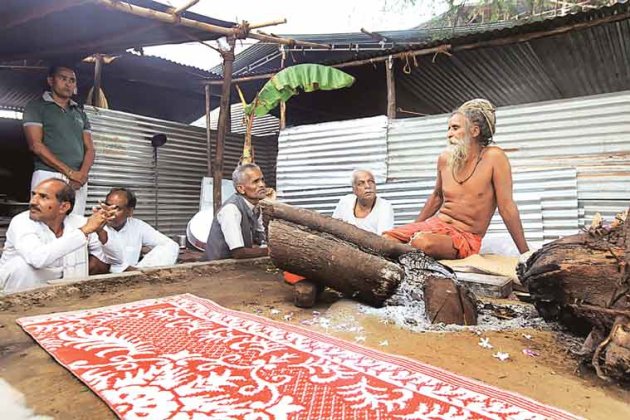
Raghavdas Maharaj or Mahant Raghavdas ji Thyagi alias Tatamari Maharaj alias Dhuni Baba
Always covered in a gunny bag, Tatamari Maharaj has been sitting in front of a thick smoke coming out of a havan for the last 20 years, according to unconfirmed sources.
His ashram called Panchi Ghat is located in Umardha Village of Hoshangabad district, Madhya Pradesh, where he claims to be offering free food to hundreds of poor devotees daily.
Kumbh Mela, Sadhus, Nashik Kumbh, Kumbh Sadhus, Stylish Sadhus, Sadhus style, Kumbh shahi snan, Golden Baba, Khadeshwar Maharaj, Bindu Maharaj, Computer Baba, Mumbai news“Tatamari Maharaj usually does not talk, we talk to the devotees on behalf of him. He is a very well known Mahant across the country for his generosity, he believes in feeding the poor,” said Ramdas, a disciple.
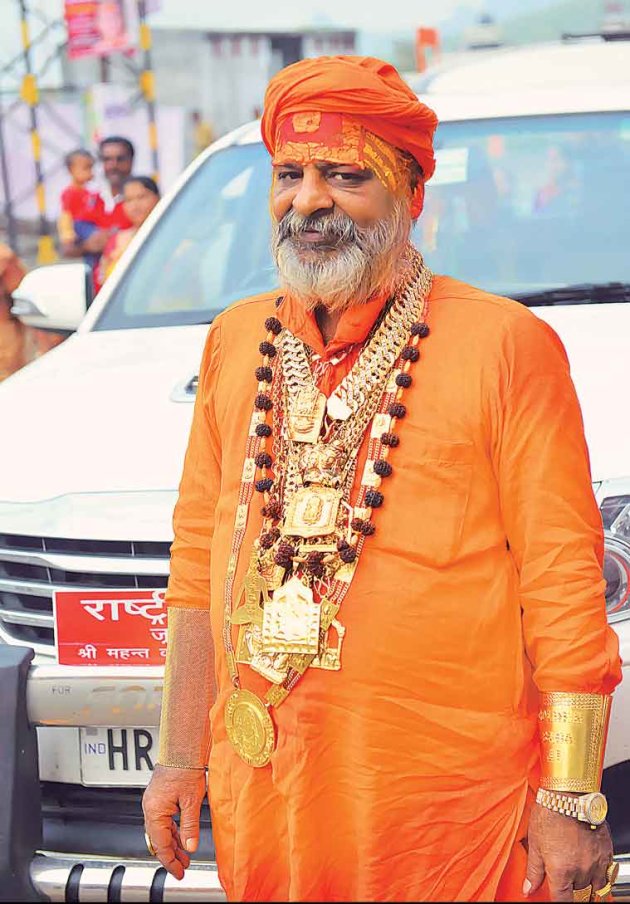
Golden Baba aka Sonewale Baba
Born as Bittu Bhagat in a Punjabi Kakkar family in East Delhi’s Gandhinagar, his fascination for gold earned him the title of “Golden Baba”. While he is seen covered in gold jewellery and accessories worth crores, he urges his followers to live a life of  simplicity. Golden Baba wears dozens of solid gold accessories around his neck and on his hands that weighs over 11.5 kg. Before becoming Golden Baba, he had gone to Haridwar with an aim to become a sadhu.
After he came back to his hometown, he built a temple and started blessing people in exchange of offerings for his ashram. He mostly accepts offerings in gold, a source from Bhagat’s Ashram told The Indian Express.  When asked where he got all this gold from and why he wears so much jewellery unlike other sadhus, he replied, “Yeh mera sona nahi hai, yeh toh eshwar ki sampatti hai (This is not mine, is belongs to God.”)
Khadeshwar Maharaj
Kumbh Mela, Sadhus, Nashik Kumbh, Kumbh Sadhus, Stylish Sadhus, Sadhus style, Kumbh shahi snan, Golden Baba, Khadeshwar Maharaj, Bindu Maharaj, Computer Baba, Mumbai newsThis particular sadhu has been meditating and performing tapasya in an unique way. His particular tapasya involves performing all the acts by standing — even while he is  sleeping, eating or carrying out other routines. This is how he got his name as Khadeshwar Maharaj.
Clad in a white cloth, Maharaj claims to have not sat down since 1988. He and his chelas (aides) call this act as khadi tapasya. When asked why has he chosen this sort of tapasya and how is it going to help, he angrily questioned back, stating, “why does the Army guard our borders?” “ I had realised long ago that these politicians, who cannot ensure safety of their own house, how can they save the country. They can only think of making money. Since olden days, this is evident that whenever the world is in danger, it is the saints, ascetics and seers who have come to the rescue. My tapasya is for the safety and well-being of the world,” he reasoned.
Ramnaresh Desai Maharaj Gujaratwale alias Underground Baba alias Bhumi Baba
Kumbh Mela, Sadhus, Nashik Kumbh, Kumbh Sadhus, Stylish Sadhus, Sadhus style, Kumbh shahi snan, Golden Baba, Khadeshwar Maharaj, Bindu Maharaj, Computer Baba, Mumbai newsBorn in Gujarat and currently residing in Bihar, Ramnaresh Desai Maharaj makes a small cave like dome, a little above the ground for himself, wherever he goes. He did the same even at sadhu gram at Tapovan for the Kumbh mela. He started doing this since 1997.
“I live under the ground in search of god, this is where I find inner peace and I can feel the almighty,” said Desai.

Friday, August 21, 2015

Kamat's Potpourri: The Holy Men of India

Since the visit of the Alexander the Great, the holy men of India have held a mysterious position to the westerners. Indeed, within India itself, their role is often misunderstood, although commonly revered. The Naga Sadhus who descend the Himalayas during the Kumbh Mela are not the same as those worshipped as deities! The former, practice cult religions such as Shakta or Naga and are typically known as Sadhus or ascetics. They are detached from life, although not necessarily devoid of its pleasures (like narcotics, sex etc.) The Sadhus practice rituals involving fire, water, yoga, and meditation, and beg for a living, following the lifestyle of  Lord Shiva.

The Rishis or sages are regarded as the bearers of the ancient Vedic values. It is believed that the Rishis who were Hindu scholars and practiced metaphysics were the originators of the Vedas and the Hindu codes of conduct. They are revered as writers of Hindu epics such as  Ramayana (by Sage Valmiki) and  Mahabharata (by Sage Vyasa). The Rishis sought moksha  through the way of knowledge (jnanamarga) and are believed to be blessed with divine knowledge. Ramakrishna Paramahamsa,  Adi Shankaracharya, and Sahajananda are some of the well-known sages and  prayers are offered to them.

The three great Acharyas or preceptors, Shankaracharya, Ramanujacharya and Madhvacharya revived and reinterpreted different traditions of Sanatana Dharma. They preached Advaita (non-dualism), Visishtadvaita (Qualified Monism)  and Dvaita (Dualism) respectively, which advocated soul-body relation and  refining of the soul. The teaching of great acharyas was restricted to upper castes, as the medium of their teaching was the Sanskrit language.

In medieval India, a profound social movement took place that was to shun  practices based on caste system and reform Hinduism. Collectively, the proponents of this movement (see: Bhakti Movement) are called as santas (saints) and they showed a new way to reach God -- through devotion (bhaktimarga). These servants of God composed brilliant music, created masterpieces of poetry and sang the Lord's glories.

The Swamijis widely followed by Hindu religious devotees are heads of sects or religious schools of thought (muthas or mathas; see The Institution of Mutha). The Swamis are typically scholars initiated into religion from a young age and are philosophers. They run educational and social institutions, engage in philosophical debates and on occasion provide political directives. 

It is common to depict the Swamis (who are elevated to the status of deities),  engaged in worship of yet another deity. This is consistent with Hindu philosophy and thought  which  puts great emphasis in peer respect and mentorship (Guru).

Some of the Swamis who perform miracles gain divine status and a very devout following. For instance, Sai Baba and  Vedic valuesSwami are widely worshipped all over the world.

Then there are the pujaris or priests. They are the professional god-men and lead family life living in (typically) temples. They perform the Hindu rituals such as birth & death ceremonies, fund raising, daily and festival worships. They are typically (but not necessarily) Brahmins, and have inherited the profession.

The following a potpourri of pictures on the holy men of India.

Table of Contents

A Muth and its Swamiji are the nucleus of cultural, spiritual and philanthopic activities
An ascetic (Sadhu) performing rituals
The class of Sadhus,includes all type of devotees, some even practising quaint rituals.
FAQ on India's Holy Men
Philosopher Madhvacharya
Picture of a Sadhu (Ascetic)
Picture of Swami Raghavendara from a Calendar Painting
Portrait of Ramana Maharshi
Portrait of Chanakya
Priest Krishna Sharma
A Priest of the Konkani Community with Vermilion on Forehead
The Rishis of India
A Sadhu at Varanasi
Sage Madhvacharya who formulated Dvaitism
Sahajananda Swami (1781-1830)
Sai Baba of Shirdi
Saint Tulasidas Writing his Masterpiece Ramacharitamanas
Swami Sahajand Saraswati
Swami Vivekananda - the Most Famous Hindu Monk
The Swamiji of the Gokarn Paratkal Muth
Swamiji of Chitrapur Muth

Tuesday, August 18, 2015

The Naga Sadhus – part of a mysterious and secret society


Naga Sadhus are a particular group of Shaivite saints who reside in the Himalayan Caves and come to visit the civilization only during the Kumbh Mela. This is the only event when these ascetic saints can be seen amongst the general Indian population.

The Naga Sadhus have unique characteristic features drawing inspiration from the famous Hindu god Shiva. They hold tridents crowned with human skulls. Their bodies are smeared in thick ash and they wear heavy coils of matted hair on the head. These saints   remain completely naked even during biting cold. They smoke Marijuana through a pipe called a Chillum or Shiv Muli. They use it as a tool to avoid the worldly distraction yet have self-control even in the intoxicated state. But as they advance in spiritual life they renounce intoxication too. The Naga Sadhus renounce the materialistic world and practice celibacy to escape from the cycle of birth and death and to attend salvation. As they belong to the Shaivite sect, they have matted locks of hair and their bodies are covered in ash like Lord Shiva.

The Naga Sadhus were founded by Dattatreya during ancient times such that the date of the foundation is lost. The ancient period was perhaps an age when humans never stressed the importance of time. Shankaracharya was the first one to organize the Nagas to protect Sanatan Dharma ( Hinduism ).

The place where the Naga Sadhus live is called ‘Akharas.’ The member of an ‘Akhara’ should always be ready for an intellectual fight and even for wrestling.

The Naga Sadhus – part of a mysterious and secret society – are worshippers of Lord Shiva. Nag means ‘naked’ and hence they are known as Nag Babas or Warrior-Ascetics. The rarely appear in public and the Kumbh Mela is one of those rare public events.

The Nag Babas are a warrior class and are divided like a regiment in an army. They have no fear of death and enraging them is a sure shot call for trouble. Their attributes are the trident, sword, stick, conch shells, other weapons and musical instruments which reflect their warrior status.

Naga Sadhus – often misunderstood by the western media as part of Indian religious gimmicks – are the epitome of renunciation. They hardly care whether they are misunderstood or called the naked holy men of India or ash-smeared and naked Hindu saints and walk unshaken on the path they have sworn for life.

Saturday, July 25, 2015

Nagas: Once were warriors

Sangam (Allahabad): The Naga sanyasis are perhaps the most photographed and the least understood of ancient Hindu cults. With their nudity, matted hair, ash-smeared bodies, andsmoking chillums, they do not make it any easier for plain rural folk -- to say nothing of urbanised Hindus - to "follow" them, just as they follow the rest of the 13 sects or akharas of Hinduism. The Nagas are forbidding and would not do anything that would help in demystifying them. "Don't mess with us," would be their apt idiom.


The Nagas engage with the world outside only after some careful prodding. And they speak in riddles. One such Naga sadhu on being asked what life meant for him, merely muttered, "Andar bela, baahar bela." That was not so tough to figure after he spoke some more after a longish silence: There's a time and universe within one's self, which has nothing to do with the time that the world follows. And they live by the rules of the universe within.

It's historically agreed that the Naga tradition began when the Adi Shankaracharya (8th century) created them as a Hindu army. The Nagas are the most heavily armed and militant of all Hindu akharas, an until this day their retreats are called 'chhaavni' or armed camps. They hold mock jousts with each other using swords, spears and tridents, and until as late as the 1950s, it wasn't unusual for them to strike to kill some one on issues of honour - even during a Kumbh mela.

With their deep veneration for the Adi Shankaracharya, it's not surprising they still chant, "Shankaram Shankaracharyam Keshavam Badyarayanan/Sutra bhashya kato bande Bhagwate punah punah." This is the Shaivite equivalent of "Dharma samsthapanaarthya sambhavaami yuge yuge". Which, of course, paraphrased in their context would read, "I, that is Shiva, is born in every age to save the world from itself."


Born in Kalady, in Kerala, Shankaracharya is said to have left home at age five and travelled across India to create the Dashnaam Sanyas ashrams primarily out of Giris (mountain sects), Puris (from towns/cities), Saraswatis (priests), Van-Aranyaks (forest hermits), and Sagar (seaside sects). Realising the need of shaastra (knowledge) as well as shastra (weapons), Adi Shankaracharya made shaastra the preserve of the acharyas and shastra the "ornaments" of the Nagas. It was these militant Nagas who were instrumental in "winning back" Hinduism from Buddhism.

Once warriors, what do the Nagas do now? Some of them have formed ramta panch (organisation of wandering monks) and are part of the Dashnam Sanyasi tradition. The Dashnami Nagas move on foot from one Kumbh to another holding Shankaracharya's flag and danka (a kind of drum) covering thousands of villages and say they remain at the forefront of protecting Hinduism. The rest remain as impervious as ever.