Showing posts with label Naga Sadhus live. Show all posts

Tuesday, August 18, 2015

The Naga Sadhus – part of a mysterious and secret society


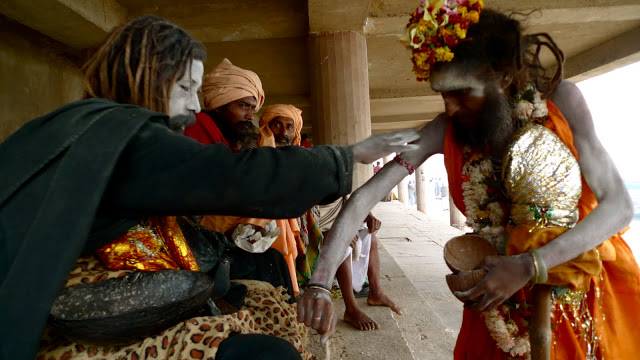
Naga Sadhus are a particular group of Shaivite saints who reside in the Himalayan Caves and come to visit the civilization only during the Kumbh Mela. This is the only event when these ascetic saints can be seen amongst the general Indian population.

The Naga Sadhus have unique characteristic features drawing inspiration from the famous Hindu god Shiva. They hold tridents crowned with human skulls. Their bodies are smeared in thick ash and they wear heavy coils of matted hair on the head. These saints   remain completely naked even during biting cold. They smoke Marijuana through a pipe called a Chillum or Shiv Muli. They use it as a tool to avoid the worldly distraction yet have self-control even in the intoxicated state. But as they advance in spiritual life they renounce intoxication too. The Naga Sadhus renounce the materialistic world and practice celibacy to escape from the cycle of birth and death and to attend salvation. As they belong to the Shaivite sect, they have matted locks of hair and their bodies are covered in ash like Lord Shiva.

The Naga Sadhus were founded by Dattatreya during ancient times such that the date of the foundation is lost. The ancient period was perhaps an age when humans never stressed the importance of time. Shankaracharya was the first one to organize the Nagas to protect Sanatan Dharma ( Hinduism ).

The place where the Naga Sadhus live is called ‘Akharas.’ The member of an ‘Akhara’ should always be ready for an intellectual fight and even for wrestling.

The Naga Sadhus – part of a mysterious and secret society – are worshippers of Lord Shiva. Nag means ‘naked’ and hence they are known as Nag Babas or Warrior-Ascetics. The rarely appear in public and the Kumbh Mela is one of those rare public events.

The Nag Babas are a warrior class and are divided like a regiment in an army. They have no fear of death and enraging them is a sure shot call for trouble. Their attributes are the trident, sword, stick, conch shells, other weapons and musical instruments which reflect their warrior status.

Naga Sadhus – often misunderstood by the western media as part of Indian religious gimmicks – are the epitome of renunciation. They hardly care whether they are misunderstood or called the naked holy men of India or ash-smeared and naked Hindu saints and walk unshaken on the path they have sworn for life.

Wednesday, August 12, 2015

Introduction to Aghori Saints

AGHORI's are called cannibals by some, while some view them as dirty sect which destroys the image of Hinduism in the world. They are believed to be devotees of ‘Lord Shiva’. According to the Aghori's every human is a ‘shava’(dead body) with emotions and they should try to become ‘Shiva’ by denying the human pleasures and involving in the Aghori rituals. It is believed that they possess miraculous healing power, and some even heal the person by cursing him. ‘If an ‘Aghori Baba’ curses you, that means your problems will end soon!’ – claim some people who are believers and followers of such sadhus.

Life of Aghori Sadhu

The life of an Aghori Sadhu is not easy, to become like them one has to meditate about twelve years and complete certain rituals under the guidance of an Aghori guru in order to enhance one spiritual strength. Aghoris use woods from pyre, clothes from dead bodies, and ash of burnt bodies for the various rituals. There are certain rules one must follow to become an Aghori. Firstly an Aghori must find a teacher and do what the teacher tells him to do. And Aghori must find a human skull known as “kappala”. And use only this as a ritual tool before initiation. An Aghori must apply pyre on his body to symbolically show the nature of the Lord Shiva.

Aghori culture

The Aghori culture is quite strange and frightening for an ordinary people. They practice meditation and they usually stay in forest or by the riverside. The most frightening fact about them is they enjoy cannibalism. They eat human flesh digging the dead body from the crematory places or from the grave yards. They consider it as a Bhakti (religion). They usually live near the grave yards or crematoriums and start to dig the ground or search the flesh after the cremation process is done. They also collect the woods and logs usually left over from the crematory areas and they cook their foods from the same woods. 
  
There are large number of Aghori community in India and many of them throng to Pashupati Nath during Maha Shivatri. They have pretty much a nomadic lifestyle. They stay in community and share their culture with each other. They justify their act of eating human flesh as holy. As per their logic when a person dies he just becomes a useless body of flesh his soul simply escapes from the body. And same things happen with the other animals so there is no difference between eating a dead chicken or other animal or a dead human being.
.
Aghori's not only eat dead people but they also eat other animals like goat or chicken but they never eat cows. They also drink alcohol and smoke cannabis(weed,hashish).The ritual practices of the AGHORI are symbols of their non-dualistic beliefs.
.
The corpse upon which they meditate is a symbol of their own body and transcendence of the lower self and realization of the Supreme Self.They are far beyond the human civilization and they do not bother to care whats happening in the outside world.. they have their own world and style of living have their own world living in between normal human beings likes us.

Monday, August 10, 2015

Naga sadhu with ‘hanging leg’ attracts pilgrims


VARANASI: Naga sadhus are popular for their unique antiques, which attracts devotees towards them. One such Naga sadhu from Gorakhnath Akhara is drawing the attention of the public at Darbhanga ghat here. The sadhu, Baba Vijay Nath, has been sitting by resting his one leg on a wooden swing for past six months for the welfare of the world. 

Baba Vijay Nath, a native of Haryana spends around 21 to 22 hours on this Hatha Yoga a day. 


He gets off the swing only to walk when necessary. Interestingly, this Naga sadhu, who came to city from Maha Kumbh Mela with six others, was spotted at Darbhanga Ghat in his peculiar posture. Cladded in saffron coloured clothes, ash smeared on his head with matted hair, the saint has prepared a small, temporary shelter at the ghat since past three days. He was spotted sitting on a wooden block, which was suspended with a rope. He rests one of his legs on the wooden block while the other leg hangs down from the swing. He has taken the pledge to stay like this for a period of 15 months. 


His unique posture has attracted many onlookers including tourists and locals. Although Baba was reluctant to speak to people, he was found sharing his experiences and cracking jokes with foreigners in inexplicit English. "There are so many evils in the society like corruption, violence, slavery, torture and a lot of misery and suffering. Condition of women is deteriorating; the Delhi gang rape case is one example. The aim of my yoga is to pray for the welfare of every one and to let the good prevail, leaving behind the negative energy which is dominating the human mind", shared Vijay Nath. 

He further said, "Hatha Yoga is a part of Hindu religion; I have taken similar sankalp and performed Hatha yoga on several other occasions. This time the sankalp is for 15 months, out of which six months have already passed". 

Friday, July 31, 2015

Linda meets a "real" sadhu on the banks of the Ganges

So it's early morning, before sunrise, in Varanasi. i'm staying at the Yogi lodge in goudalia, the old, smelly, labyrinth of Varanasi old city. my travel companion, Katja, is sleeping sweetly on her thin, stained mattress, bundled up with a trillion dusty blankets. 


i'm hunting for a real Aghori baba.


I did my dissertation at uni about the Pashupatas- the really nasty, crazy renunciates, who follow Shiva. they eat dead flesh, they live at the burial grounds, they smear their bodies with ashes from the funeral pyre. they drink water from a human skull, and they behave in different funny, weird ways, to be like Shiva. they scare people and they give respect.


apparently, these sadhus only exist today in Nepal, in the Pasupatinath. 
but, I had read and heard, that another, related tribe of sadhus, called "Aghoris", still could be found in Varanasi, close to the burning ghat, where human bodies were burning day and night. 


walking, early that morning, towards the burning ghat. the river Ganga was misty and grey, but many little lights were slowly flickering with the soft wave movements of the dirty river. people were swimming and bathing, performing rituals just below the steps; I was drinking sweet, sweet chai from a tiny plastic cup.


at one moment I decided to go down and sit on one of the platforms facing the river. I decided that things would come to me, if I only relaxed. 
I was looking out at the river, gradually increasing in grey misty light, and at one point I looked back towards the buildings behind me- and I could not believe my eyes when I saw this figure walking towards me. It was a dream come true. he was actually walking out to the platform where I was sitting. this weirdly dressed and painted creature- an Aghori baba?


He looked at me, asked if he could sit down (hand-language) and I of course, invited him to sit, and I could not hide my curiosity, I immediately starting feeling his hair, clothes, looking at his tools, ornaments. of course, as is always customary in India, another guy shows up, and offer his services as a translator. it was helpful, because the baba did not speak English, and my Hindi is limited to like 11 words. 

The baba said that he was indeed an Aghori sadhu. that he ate dead flesh. that he used the ashes to cover his body. he showed me the skull that he drinks from. he was very eager to share with me, he seemed almost to enjoy all the attention. when I asked if I could take pictures, he started posing, and got more and more into it- he changed the position of his animal-printed shawl, and at one point asked me to film him, as he did his "scary, crazy, Shiva-laugh."


uffering. they are painful to walk in- it is "tapas"- to work on his karma. 
i tried to give him money and he did accept, reluctantly- actually, he seemed to just love the attention that he got from me. my fascination was pouring out of my eyes- while, underneath, inside me, I had the feeling that his plastic skull and cheap ornaments were actually just a facade, a theater-costume. even his animal-print shawl, I remember seeing at the market-stalls by the main ghat. 

parted, I continued walking along the river, and met several other babas, homeless, weird and wonderful people. at one point, under the bridge of the main ghat, I encountered my aghori baba again. here, he is helping another sadhu covering his skin in "ashes". this other sadhu looked like he was close to death- so weak, so thin, with eyes almost popping out.


internet-place, where we had made good friends with the family that owned it, I told them I had met an Aghori baba. the laughter that came in response was both infectuous and humiliating. 
a "real" Aghori would never walk around in daylight, and much less would he CLAIM to be an Aghori. it's like claiming you are enlightened! and, worst of all, they told me that these shoes that he was wearing; they all wear them at home. for stimulating the blood flow. bah. 
this guy is FAKE, FAKE, FAKE! and you stupid tourist bought his story... ha ha ha... hrrrmmmm...
well. ok. I might have been naive. 
BUT.
honestly. which normal dude would walk around dressed like that?
my chase and hunt for the "real" sadhus in Varanasi was neverending. I never did manage to find one that seemed "real". they all wanted either attention, money, whiskey, cigarettes or their picture taken. mostly all of it. 
BUT.
my point is.


if a man chooses to walk away from a family life, for whatever reason, from making money, for whatever reason, and to live off what they are given, then their story must surely be very interesting. 


I'm sure many of them are criminals, homosexuals...whatever one can think of that would not fit into the Indian society. they escape the law and the public by "renouncing" "normal" life, and they choose to become "holy men". this, in itself, is fascinating to me. real, or not real.

Sunday, July 26, 2015

Hariakhan Babaji Maharaj

Who was this person called in the West Babaji after his story was first told in Autobiography of a Yogi? Actually the name Babaji is somewhat generic and has been applied to many sages over the years. The word Baba means father and the suffix "ji" is one of respect. But the Babaji written about here is called by many names such as Mahavatar Babaji, Hariakhan Babaji, Babaji Maharaj (great king), Shiva Baba (denoting his close connection to God Shiva), also Bhagavan Sadashiva, Sri Sadashiva, Mahamunindra, and Sri Sri Baba.

Hariakhan Baba Maharaj is a Great One, said to have been alive for thousands of years, dwelling in various caves in the Himalayas, appearing sometimes among men to accomplish some particular goal but always watching over the welfare of mankind from the sidelines. Though many people saw him in both the 19th and the 20th century, his appearance was always that of a young man in early manhood. He was tall and slender with a noble and dignified appearance and in nature was humble, kind and childlike. His complexion was light and his hair sometimes worn long and sometimes short. Details of his appearance varied even when he was observed by several people at the same time. He spoke little and seldom ate unless given food by devotees. He never slept, and when on the move, he walked very fast. His appearances and disappearances were always sudden and unexpected. He had great strength of body and was often seen lifting huge rocks. Sometimes he was seen with several Tibetan Lamas and in fact Babaji was often seen wearing a shirt and Tibetan cap over his head. He spoke a mixture of many languages including Nepali, Hindi, and Kurmachal languages. Whenever he talked to anyone from a particular region of India, he spoke to them fluently in their own native language. Nobody knows when he was born or where. He had all the known siddhas (Yogic powers) and occasionally performed miracles in a natural way according to the circumstances at hand. But mostly people were drawn to him because of the bliss they experienced in his presence. 

He appeared in many places in Northern India near the Himalayas between 1861 and 1924. At that time he was known by different names in the different regions and people didn't realize these were different names for the same person until a man named Mahendra Brahmachari had a vision of him in 1949. He subsequently became a devotee of Babaji Maharaj and spent thirty-five years traveling all over India, collecting the stories told about encounters with the great Babaji. He published these in India under the title Punya Smriti using the pen name Guru Charnasrit. There was also a book about him titled Hariakhan Baba, Known, Unknown by Baba Hari Dass published in America in 1975 by the Sri Rama Foundation. 

The stories that follow are just a few of the many recorded incidents about him and they present different facets of the great master. 

Thursday, July 23, 2015

Naga Sadhus aren’t meant to be just Naked and “High on Pot” Ascetics; Real Ones Embody the Grace of Shiva beneath the Veneer of societal disdain

Who are Naga Sadhus?
To understand the Naga Sadhus, it is important to know who Shiva is.  Because these ascetics – those who are really on Spiritual path and seriously with a Guru who knows what he doing, as opposed to just a naked Sadhu taking intoxicants – are on the path as closely aligned to the life of Shiva, the original Yogi, as it can possibly get!
For the Yogis, Shiva is not a “God”.  He is the origin of all Spirituality.  When he walked the earth, he did so with complete disdain for the society or social norms and niceties.  He was himself always in bliss so fully that he didn’t really care for the society at large.  And when he interacted with the Society, he did on his own terms.  Walking around with ash all over his body(from the cremation grounds) – a reminder of the temporal nature of the body – and large hair tied carelessly, with rowdy and demented alien beings who never fit in any society.
Society is an organized way of living.  It has to have its own norms – formal and informal.  Laws, principles and limitations of being in a society are important for it to function.
In Hinduism, a society has been engaged with in three different ways to show the worthlessness of the societal norms to a Spiritual Seeker or an Enlightened Being.
One could, if one had complete control over one’s ownself, live fully within the limits of the society and never cross any of the set limits, and yet be an Enlightened Being.  The world will keep judging such a person for his inability to break the norms, not realizing that he has deliberately chosen to remain fully and completely within them knowing their worthlessness and knowing that it is after all a play.  Such a life was lived by Ram.
One could also live within a society, but not live by any contemporary norms.  Such a being – while Enlightened – could play around with every norm to get his work done to establish Spiritual Order.  An order where men and women live in more awareness.  Where, even if women are confined to their homes in any time and age, and forced to live a life of devotion to her family, can find a way to play around that norm as well by dipping deeply in her devotion for something far more profound.  Such a life was lived by Krishna.
One could also just denounce the society in a way that one doesn’t even consider it worth his while.  And he engages ONLY when his compassion is poked by the devotion of an extremely resilient devotee.  When a devotee with single minded focus forces him to take notice, ONLY then such a being even agrees to engage and touch the world, in ways and compassion very few can come up with.  Such a life was lived by Shiva.
Between living in a society fully within the norms without opposition;  to living within a society but playing around with norms; to treating the society itself with disdain unless cajoled by unrelenting devotion; all three “engagement models” with the society have been demonstrated.
Most Ascetics are inspired by Shiva.  They leave society for they do not find anything worth craving for in it.  And, in their own way, take up a veneer that is “anti-social” so that they aren’t bothered by the society at large.  Naga Sadhus are one such bunch.
But this is not an easy path.  It requires a lot of Sadhana and lot of discipline.  One wonders how many of the Naga Sadhus of today understand the depths and the profundity of their path.  Because the way they show themselves off these days is that they are naked and high on marijuana.  Being high and being stark naked may seem “romantic” and “esoteric”, but these two things aren’t enough to make you a Spiritual Seeker.
Just as there are lots of people going through Medical Colleges, but not all can really be called Doctors as to how they can really solve the health issues of their patients.  It is the same with the Naga Sadhus.  Some of the Naga Sadhus from hundreds who come from so many Akharas and who descend on the MahaKumbh would actually be truly reflecting the Disdain for Society of Shiva coupled with an extreme level of compassion for true and unrelenting devotion. Those few who  embody the Grace of Adi-Yogi Shiva beneath the strange veneer that shouts disdain for the society are rare.  Those – even a handful – are the ones who make going to Mahakumbh worth all your effort.

Thursday, July 9, 2015

Who are Naga Sadhus?

Who are Naga Sadhus?


Naga Sadhus are a particular group of Shaivite saints who reside in the Himalayan Caves and come to visit the civilization only during the Kumbh Mela. This is the only event when these ascetic saints can be seen amongst the general Indian population.


The Naga Sadhus have unique characteristic features drawing inspiration from the famous Hindu god Shiva. They hold tridents crowned with human skulls. Their bodies are smeared in thick ash and they wear heavy coils of matted hair on the head. These saints   remain completely naked even during biting cold. They smoke Marijuana through a pipe called a Chillum or Shiv Muli. They use it as a tool to avoid the worldly distraction yet have self-control even in the intoxicated state. But as they advance in spiritual life they renounce intoxication too. The Naga Sadhus renounce the materialistic world and practice celibacy to escape from the cycle of birth and death and to attend salvation. As they belong to the Shaivite sect, they have matted locks of hair and their bodies are covered in ash like Lord Shiva.

The Naga Sadhus were founded by Dattatreya during ancient times such that the date of the foundation is lost. The ancient period was perhaps an age when humans never stressed the importance of time. Shankaracharya was the first one to organize the Nagas to protect Sanatan Dharma ( Hinduism ).

The place where the Naga Sadhus live is called ‘Akharas.’ The member of an ‘Akhara’ should always be ready for an intellectual fight and even for wrestling.

The Naga Sadhus – part of a mysterious and secret society – are worshippers of Lord Shiva. Nag means ‘naked’ and hence they are known as Nag Babas or Warrior-Ascetics. The rarely appear in public and the Kumbh Mela is one of those rare public events.

The Nag Babas are a warrior class and are divided like a regiment in an army. They have no fear of death and enraging them is a sure shot call for trouble. Their attributes are the trident, sword, stick, conch shells, other weapons and musical instruments which reflect their warrior status.
Naga Sadhus – often misunderstood by the western media as part of Indian religious gimmicks – are the epitome of renunciation. They hardly care whether they are misunderstood or called the naked holy men of India or ash-smeared and naked Hindu saints and walk unshaken on the path they have sworn for life.