Showing posts with label Naga Sadhus. Show all posts

Tuesday, August 18, 2015

The Naga Sadhus – part of a mysterious and secret society


Naga Sadhus are a particular group of Shaivite saints who reside in the Himalayan Caves and come to visit the civilization only during the Kumbh Mela. This is the only event when these ascetic saints can be seen amongst the general Indian population.

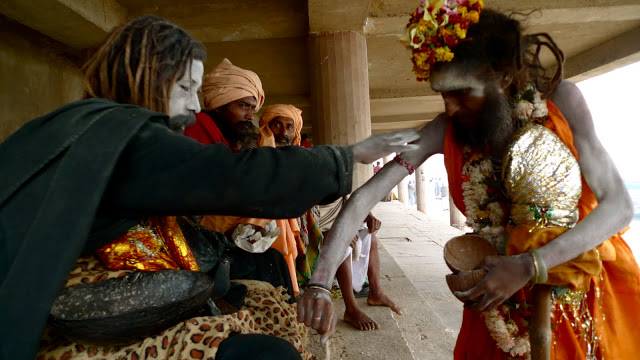
The Naga Sadhus have unique characteristic features drawing inspiration from the famous Hindu god Shiva. They hold tridents crowned with human skulls. Their bodies are smeared in thick ash and they wear heavy coils of matted hair on the head. These saints   remain completely naked even during biting cold. They smoke Marijuana through a pipe called a Chillum or Shiv Muli. They use it as a tool to avoid the worldly distraction yet have self-control even in the intoxicated state. But as they advance in spiritual life they renounce intoxication too. The Naga Sadhus renounce the materialistic world and practice celibacy to escape from the cycle of birth and death and to attend salvation. As they belong to the Shaivite sect, they have matted locks of hair and their bodies are covered in ash like Lord Shiva.

The Naga Sadhus were founded by Dattatreya during ancient times such that the date of the foundation is lost. The ancient period was perhaps an age when humans never stressed the importance of time. Shankaracharya was the first one to organize the Nagas to protect Sanatan Dharma ( Hinduism ).

The place where the Naga Sadhus live is called ‘Akharas.’ The member of an ‘Akhara’ should always be ready for an intellectual fight and even for wrestling.

The Naga Sadhus – part of a mysterious and secret society – are worshippers of Lord Shiva. Nag means ‘naked’ and hence they are known as Nag Babas or Warrior-Ascetics. The rarely appear in public and the Kumbh Mela is one of those rare public events.

The Nag Babas are a warrior class and are divided like a regiment in an army. They have no fear of death and enraging them is a sure shot call for trouble. Their attributes are the trident, sword, stick, conch shells, other weapons and musical instruments which reflect their warrior status.

Naga Sadhus – often misunderstood by the western media as part of Indian religious gimmicks – are the epitome of renunciation. They hardly care whether they are misunderstood or called the naked holy men of India or ash-smeared and naked Hindu saints and walk unshaken on the path they have sworn for life.

Monday, August 10, 2015

Smokin' Sadhus: India's wandering holy men make puffing hash their sacred ritual


The half-naked man pushes back his orange turban and gets down to work. He breaks off chunks of hash and mixes them with tobacco in his bony fingers, then dumps the contents into a chillum (conical clay pipe).
The flaming wooden match lights up the painted lines on his forehead as he shouts, "Bom Shiva!" and starts puffing away, his head disappearing behind a cloud of smoke.


After two massive lungfulls, he passes the pipe on to his brethren, more thin men dressed in a minimum of cloth, with long beards, matted hair, and a happily glazed look in their eyes.

They are sadhus, India's wandering holy men. They have renounced their worldly life, said goodbye to both their possessions and their families, and now lead a life of celibacy, ascetic yoga, and a search for enlightenment.


Most make pilgrimages across the subcontinent and spread ashes on their body, while the most radical test themselves by holding one arm in the air for years on end or spending twenty-four hours a day standing up. A far more pleasant and widespread characteristic, however, is the tendency to get stoned out of their minds on a regular basis.


Out of their minds

In fact "out of their minds" is a good goal to shoot for, as rational thought then gives way to a less earthly purpose. Like tribal North Americans drinking peyote mixtures or Rastafarians lighting up a big spliff, the purpose is a journey to a higher plane.

While sadhus can be divided into a zillion different sects, most follow either the god Vishnu (the preserver) or Shiva (the destroyer, and thus, the rejuvenator). While many followers of Vishnu manage to find reasons to smoke charrus (hash) for enlightenment, it's the latter group that really has a ready excuse. Shiva is generally pictured meditating alone in the Himalayas, his eyes half closed from the effects of his hash habit. 

As Dolf Hartsuiker puts it in his authoritative book Sadhus, the Holy Men of India, "Mythologically, charas is intimately connected with Shiva: he smokes it, he is perpetually intoxicated by it, he is The Lord of Charas." Or as one young sadhu less eloquently put it, "Shiva is a cooool god!"


This perception goes a long way in explaining the Indian government's lax attitude toward marijuana and hash. Thousands of backpackers descend on India each year, some of them lured by easily available cannabis and hash.
While the police have cracked down in Goa, where only foreign tourists are partaking, they stay out of the way elsewhere, especially in pilgrimage areas. Dry up the supply of hash and they'll have some very unhappy sadhus to deal with. And since the sadhus are thought to be representatives of the gods… well, no Hindu cop wants to be on the God of Destruction's s**t list.
So by becoming social outcasts and smoking ganja or charas, the sadhus can claim that they are only trying to emulate Shiva. If even the most devout Hindu man were to sit down to talk with a group of sadhus, he would have no choice but to join in if the chillum came his way. To refuse the pipe would be to pass up the chance, the obligation really, to share a holy experience with the ascetics.

Steady stream of visitors

And many people do join them. As I sat for a half hour with a group of three sadhus near Manikaran, a steady stream of visitors came through: an old woman depositing some coins and flowers by a shrine of tridents, a farmer dropping off some vegetables, and two broken-down truck drivers with a big hunk of charas to share.

The last two were most warmly welcomed. When I naively asked one sadhu how he got around the country, he looked puzzled. "Train is free," he said simply. "Food free, train free, charas free. Baba's life is good life."

Of course there's a fine line between living off alms and being a shameless beggar. Some men draped in orange rags are merely the latter seeking a more profitable method. Those who hang out around backpacker guesthouses are particularly suspect, as are the elaborately costumed and painted men in Kathmandu's Durbar Square, fakes who aggressively hit up vacationing tourists for photo money. "Those guys are no holier than me," scoffed one Nepali shopkeeper nearby. "They're much richer though-I ride a bike to work each day but that fat one takes a taxi from his house!"


Of those that are for real, not all of them reach enlightenment, but what religion makes the effort so much fun? Besides, after they've smoked for twenty years solid, few are probably going to be too bothered about much of anything, including whether they've seen the light or not. More importantly, just by becoming a sadhu they've detached themselves from the reincarnation wheel and become casteless-a big motivation in itself for those who were on the bottom rung before.

To top it off, the afterlife is a nice one as well. According to Hindu beliefs, when a sadhu dies he leaves his body and floats off to Mount Kailash, the source of the Ganges River and the home of Shiva. There he goes about a life of doing pretty much what he was doing anyway: smoking heavenly hash and meditating in divine bliss. This probably offers some explanation as to why most don't seem to concerned about their health. 

Bone shaking coughs

A lot of the older ones have obviously been at this a long time. Many have a beard that tickles their navel and long locks wrapped into a towering bun on their head. (You put your weeeed in it man!) They also have little in the way of muscles left and many have a bone-shaking cough that would make a lung specialist wince. Others display the classic signs of potheads the world over: little energy, a lack of motivation, difficulty maintaining a train of thought, and scant attention to personal hygiene. And when shooting photos of these guys with a flash, using the red-eye reduction seems pretty pointless.

It must be noted, though, that there are quite a few sadhus who don't smoke at all. Somewhere, somehow, they got the idea that it was counter-productive.


Saturday, August 8, 2015

This American Photographer’s Captivating Portraits Of Sadhus In Varanasi Will Truly Amaze You


Relinquishing worldly possessions and pursuing a life of spirituality and meditation is a fascinating concept. We've all heard of sadhus, spiritual leaders and gurus leading lives wholly devoid of everything we today think are indispensable. New York based  photographer Joey L. however was so taken by this idea that he travelled around the world to document the lives of monks and sadhus. He recently documented some mesmerizing aspects of the sadhus in Varanasi in his journey. It came out in the form of stunning portraits & a captivating film called 'Beyond' which filmmaker Cale Glendening shot during his visit. 

Have a look. It'll definitely urge you to take a look within and think beyond the material life.

You can find Joey L's work right here


Wednesday, August 5, 2015

Tainted sadhus to be kept away from Kumbh

The Ak hil Bharatiya Akhara Parish ad, the apex body of Hindu as cetic organizations, has ban ned two mahamandaleshwars (high priests) facing crimina charges from participating in the ongoing Nashik Kumbh's first Shahi Snan on August 29 and is probing a third.

Parishad president Narendra Giri told TOI that the ban was imposed as “part of the process to cleanse the community of saints of criminal elements. The Parishad has identified two controversial saints and asked their akharas to ban them. They will be allowed to attend religious func tions only after they are cleared of all charges“.

Alleged pub and discotheque owner-turned-saint Swami Sachidanand of Noida and Radhe Maa of Mumbai have been banned while Trikal Bhawanta of Allahabad is being investigated.

It is alleged that Swami Sachidanand, alias Sachin Dutta, has several criminal cases against him in Haryana and Punjab, including for fraud and land grab. A resident of Noida since 2003, Dutta also owned a discotheque and a beer pub. He took sanyas on Guru Purnima on Friday last week. Swami Sachidanand alias Sachin Dutta ran a real estate business, Balaji Construction, with his father Rajender Kumar Dutta, who retired from the UP power department as SDO Ghaziabad.

Akhil Bharatiya Akhara Parishad chief Narendra Giri said, “We've been told the discotheque and liquor business were owned by his (Dutta's) father and he assisted him. The committee will also probe his intention behind taking sanyas.“ For the last year or so, Dutta was underground.The sudden news of his becoming mahamandaleshwar surprised many including his neighbours, who said he lived a flamboyant life, very unlike a sanyasi's.

Radhe Maa, Giri said, was being stopped from the shahi snan and other religious functions because she faces charges of dowry harassment and cheating along with six others in Kandivili police station in Mumbai.“I've written to Juna Akhara head Hari Giri to stop Radhe Maa as she has courted controversies in the past,“ said Giri, adding that disputes related to seers send a wrong message and time was ripe to take extreme steps against all such controversial saints. On Trikal Bhawanta of Allaha bad, Giri said, “The process of identifying such mahants and mahamandaleshwars is under way. We'll take a decision only after receiving reports against them.

Tuesday, August 4, 2015

Gokul 1757 : War of the Nagas ~ Shiva’s Sacred Warriors

mongst the sacred points of pilgrimages of Hinduism one of the most popular regions centre around the fabled birthplace and playground of Sri Krishna known as the Braj Matsya region. This area centred around the south of Delhi is annually visiting today as in the past by thousands of the faithful often humbly treading the paths between Mathura, Vrindavan and Gokul.

However in 1757 the sacred soil of Gokul was streaming with blood. The invasion of the Afghan invader Ahmed Shah Abdali sent hordes of his soldiers pouring into the holy places. After a desperate resistance by the Hindu Jats under their prince Jawahar Singh and the death of 10,000 of his solders the city o Mathura was sacked and brutalised.
Amidst the wholesale destruction of temples and holy places thousands of women flung themselves into the Yamuna River to escape rape and slavery. Vrindavan faced a similar horror. He had detached Jahan Khan and Najib with 20,000 men, telling them,
The prime general of the Afghans, Sardar Khan ; launched an attack on Gokul. Here however stirred by the atrocities of the Afghans thousands of ash smeared warrior monks barred the way. The grim Naga sadhus armed with swords, matchlocks and cannons had called together their wandering bands to rise in defence of dharma.
In the mid seventeenth century the bands of sadhus and assorted holy men coalesced into larger groups often numbering more than 10,000 strong – they provided protection to the temples, the travel routes and even towns and rival armies. For many centuries the monks and disciples began to take up arms amidst the upheavals of northern India and during the fall of the Mughal Empire they emerged as a serious force to reckon with.
One of their notable leaders Rajendra Giri Gosain held such a reputation of bravery that his band of Nagas would contend with over ten times their numbers of enemies with utter abandon and fury. Later times saw some of the larger bands under Himmat Bahadur and Anupgir Gosain lead vast armies across the northern Indian plains
The famed Afghan cavalry launched itself against the Nagas to be met with a wild and reckless counter charge by the Nagas. The utter disregard for their own lives displayed by the Hindu holy men sent the initial Afghan attackers retreating in confusion and defeat. Reinforced some time later the Afghans returned to the attack and a bitter struggle ensued.
Both parties believed they fought for a higher power but the similarities ended there. The Afghans fought for loot, plunder and rape whilst the Naga Sadhus had already given up their worldly and material attachments and in a long tradition of warfare fought solely for dharma and faith. The Afghans fought with the reckless valour for which they were much wonted and the Nagas fought with a determination that spoke of their contempt of death.
The battle cry of ‘Har Har Mahadev’ and ‘Ya Ali’ rose above the groans and shrieks of the wounded and dying. The battle raged as dusk fell and the protagonists continued their fight stepping on the bodies of the slain until the writer observes grappling in a deathly embrace whilst slipping on the mounds of gore and blood flowing on the hallowed grounds. Still the Nagas did not give ground.
Enraged the Abdali threw further troops into the battle. His as yet undefeated soldiers who had marched victoriously from the borders of India to Central Asia were met with renewed charges and attacks from the Naga Sanyasis. They fought so desperately that the Afghans began to lose hope of victory and as their losses rapidly mounted in the failing light their leader Sardar Jahan Khan called a retreat and the Afghans fell back in defeat and humiliation  leaving many thousands of their brethren dead and wounded on the battlefield. The holy town of Gokul was saved but at an appalling cost in lives.
The Naga Sadhus saved the shrines of their faith and the thousands of refugees behind them. They exemplified the age old tradition of valour mixed with dharma – the concept of rising in arms each time they were required. They went on to fight bitter decade’s long struggles with the British expansion in India to be so famously celebrated in the late nineteenth century novel Ananda Math. Their exploits became the inspiration for the freedom fighters of the 20th Century and the living image of the warrior saints can be found in India today

Friday, July 31, 2015

Linda meets a "real" sadhu on the banks of the Ganges

So it's early morning, before sunrise, in Varanasi. i'm staying at the Yogi lodge in goudalia, the old, smelly, labyrinth of Varanasi old city. my travel companion, Katja, is sleeping sweetly on her thin, stained mattress, bundled up with a trillion dusty blankets. 


i'm hunting for a real Aghori baba.


I did my dissertation at uni about the Pashupatas- the really nasty, crazy renunciates, who follow Shiva. they eat dead flesh, they live at the burial grounds, they smear their bodies with ashes from the funeral pyre. they drink water from a human skull, and they behave in different funny, weird ways, to be like Shiva. they scare people and they give respect.


apparently, these sadhus only exist today in Nepal, in the Pasupatinath. 
but, I had read and heard, that another, related tribe of sadhus, called "Aghoris", still could be found in Varanasi, close to the burning ghat, where human bodies were burning day and night. 


walking, early that morning, towards the burning ghat. the river Ganga was misty and grey, but many little lights were slowly flickering with the soft wave movements of the dirty river. people were swimming and bathing, performing rituals just below the steps; I was drinking sweet, sweet chai from a tiny plastic cup.


at one moment I decided to go down and sit on one of the platforms facing the river. I decided that things would come to me, if I only relaxed. 
I was looking out at the river, gradually increasing in grey misty light, and at one point I looked back towards the buildings behind me- and I could not believe my eyes when I saw this figure walking towards me. It was a dream come true. he was actually walking out to the platform where I was sitting. this weirdly dressed and painted creature- an Aghori baba?


He looked at me, asked if he could sit down (hand-language) and I of course, invited him to sit, and I could not hide my curiosity, I immediately starting feeling his hair, clothes, looking at his tools, ornaments. of course, as is always customary in India, another guy shows up, and offer his services as a translator. it was helpful, because the baba did not speak English, and my Hindi is limited to like 11 words. 

The baba said that he was indeed an Aghori sadhu. that he ate dead flesh. that he used the ashes to cover his body. he showed me the skull that he drinks from. he was very eager to share with me, he seemed almost to enjoy all the attention. when I asked if I could take pictures, he started posing, and got more and more into it- he changed the position of his animal-printed shawl, and at one point asked me to film him, as he did his "scary, crazy, Shiva-laugh."


uffering. they are painful to walk in- it is "tapas"- to work on his karma. 
i tried to give him money and he did accept, reluctantly- actually, he seemed to just love the attention that he got from me. my fascination was pouring out of my eyes- while, underneath, inside me, I had the feeling that his plastic skull and cheap ornaments were actually just a facade, a theater-costume. even his animal-print shawl, I remember seeing at the market-stalls by the main ghat. 

parted, I continued walking along the river, and met several other babas, homeless, weird and wonderful people. at one point, under the bridge of the main ghat, I encountered my aghori baba again. here, he is helping another sadhu covering his skin in "ashes". this other sadhu looked like he was close to death- so weak, so thin, with eyes almost popping out.


internet-place, where we had made good friends with the family that owned it, I told them I had met an Aghori baba. the laughter that came in response was both infectuous and humiliating. 
a "real" Aghori would never walk around in daylight, and much less would he CLAIM to be an Aghori. it's like claiming you are enlightened! and, worst of all, they told me that these shoes that he was wearing; they all wear them at home. for stimulating the blood flow. bah. 
this guy is FAKE, FAKE, FAKE! and you stupid tourist bought his story... ha ha ha... hrrrmmmm...
well. ok. I might have been naive. 
BUT.
honestly. which normal dude would walk around dressed like that?
my chase and hunt for the "real" sadhus in Varanasi was neverending. I never did manage to find one that seemed "real". they all wanted either attention, money, whiskey, cigarettes or their picture taken. mostly all of it. 
BUT.
my point is.


if a man chooses to walk away from a family life, for whatever reason, from making money, for whatever reason, and to live off what they are given, then their story must surely be very interesting. 


I'm sure many of them are criminals, homosexuals...whatever one can think of that would not fit into the Indian society. they escape the law and the public by "renouncing" "normal" life, and they choose to become "holy men". this, in itself, is fascinating to me. real, or not real.

Wednesday, July 29, 2015

10 FACTS ABOUT THE GRISLY AND MYSTIC AGHORI SADHUS OF INDIA

The most feared and the most respected clan of sadhus or ascetics of India , the Aghori sadhus are notorious for their uncommon and grisly rituals they perform as a part and parcel of their religious routine, enough to arouse curiosity and awe among the public. Before going to facts lets know who the are.

WHO ARE AGHORI?

Aghori is a peculiar clan of of sadhus or ascetics of India. The Aghoras is said to have been over 1000 years old, the first Aghora sadhu being Keenaram. They inhibit the city of Varanasi (Banaras), alongside the banks of the river Ganga, where the most revered temple of Kasi Vishwanath stand proudly. Aghoris are devotees of Shiva manifested as Bhairava, who seek moksha from the cycle of reincarnation. This freedom is a realization of the self’s identity with the absolute.
So, below is the list of odd and amazing facts about the lives of these Aghori Sadhus, a sect of people who revere and relish what we usually dread – Death.
  • Profanity is the route to Nirvana:
For Dhuniwale Bhaba (as the locals call him) cursing in an utterly profane manner for virtually no reason. And is the only way he claims that can lead him to Nirvana or ultimate enlightenment. An incident reveals that when a man approached the baba seeking blessings regarding his daughter’s wedding, the baba cursed the man using utter obscenities and that his daughter would rot in hell. After three days the man was reported to have approached the baba again with some sweets stating that the baba’s blessings solved his problem. The Dhuniwale Bhaba is also notorious for throwing faeces on people who demand his blessings and the most awful yet unbelievable fact is that the people are very contended with his ‘prasad’ and some even take it home.
The nasty appetite:
All over India and among other curious westerners, the Aghori are well known for their extremely revolting appetite. Their food habits include whatever a civilized human being will not eat at any cost, such as rotten foods, foods from dump site, animal faeces, animal urine and putrefying human corpses which are most often eaten in a cup made of human skull. But they seem to have their own reasons for their nasty appetite. Consumption of excreta is said to kill ego and derail the human perception of beauty, which is essential for a man to lead his life as an Aghora.
  • Tailanga Swami:
Here comes another baba who did the unimaginable again. This baba is hailed as very powerful by the people of the locality. Records say that he was slapped and driven out of the Kasi Viswanath temple by a priest when he was worshipping and performing a puja on the sculpture of Lord Shiva using his own excreta. History says that Lord Shiva himself appeared in the dream of the local king of Benaras and complained about the insult meted out to Tailanga Swami, and also revealed that the swami was an incarnation of his holiness himself. The priest was also found dead mysteriously, later.
  • Legitimate Cannibalism:
In spite of Varanasi being a densely populated city, Cannibalism is openly practiced by the Aghoras in Varanasi without any public upheaval as they usually do not kill humans for their necrophagic needs, but only consume corpses from cremating grounds. Corpses are eaten raw and at times they are roasted over open flame. After eating a certain quantity of flesh, they start meditating sitting atop a corpse which is continued all night. If cannibalism amidst a populated city is not awkward enough, move on to the next item in the list.

  • A Creepy sense of fashion:
Aghoras are known for their spooky sense of fashion. They move about in the city with nothing more on their bodies except a skimpy jute loin cloth and at times, nude. Being nude, in their terms is complete renunciation from the material world and its attachments. Most often, they smear their bodies with ash from human cremated remains to cover their nakedness. Talking about accessories, Human skulls are worn as jewelry around their necks. Some Aghoras(or Aghori) are also reported to roam around with the femur (thigh bone) of cremated people as a Aghoran symbol. (May be as a walking stick). They never cut their hair, letting it to fall to their knees, making Agoras to be easily spotted anywhere amidst a hell of a crowd.
  • Mysterious medicines:
To the surprise and awe of the scientists all over the world, The Aghoras claim they have medicines that can treat some of the most stubborn diseases such as Cancer and even AIDS. You guessed right. These medicines called ‘human oils’ come from burning the human body collected from the burning pyre. The babas claim that these medicines are very effective on curing the above mentioned diseases but are not used in modern medicine due to ethical considerations. However, the authenticity of their claim has never been tried and tested yet by the scientific community.
  • Tantric powers and Black magic:
The healing powers of Aghori Sadhus are said to come from their expertise in Black magic. What they say about these practices is that they never use their powers for harmful deeds. instead they absorb the diseases that plague the victims who visit them into their bodies and eliminate the diseases by burning them using Black magic. Certain Aghori who intensely practice Black magic say the more they please Lord Shiva and goddess Kali, the more they gain powers of control over the environment and the forces of nature. But they never do it, as they adore and respect Mother Nature.
The ‘left way’ to reach god:
It may seem a pun, but actually it isn’t. While the whole world follows the right way to reach god, these sadhus proudly assert that they follow the ‘left way’ to reach god which is far quicker than the former. According to them, true godliness lies in seeking the ‘purity in the filthiest’. One of those sadhus says they are true Aghoras if they were able to concentrate on god while performing the most perverted acts such as necrophilia, necrophagy and Coprophagy. To mention, the right ways to reach god include veganism, sanctity and abstinence from lust according to Hinduism.
  • Mantras, Tantras and Marijuana:
No Aghora would ever abstain himself from smoking Marijuana because they believe it is marijuana that helps them concentrate on religious mantras and the strenuous yogic practices they perform by routine. In spite of being under the effect of marijuana all the time they appear very sober and calm. When asked by curious visitors that whether they consume weed for pleasure, they abruptly deny the assertion. The delusion and hallucinations provided by weeds are taken as religious ecstasies and heightened spiritual experiences.
  • The ‘Five M’ Concept:
And finally, The Agoras are cool enough to compile their beliefs into a 5M protocol. The five M concept has many other different versions , but the Aghoric version of the 5M concept or Dakshinakara has its own translation of the original.
Madya – Wine (which means a heavenly fluid which drips from the glands of human brain.)
Mamsa – Meat (swallowing the tongue)
Matsya- fish (twin-fish an ‘8’ shaped structure which forms a part of the backbone)
Mudra- parched grain (positions of Kundalini yoga, followed by Aghori ascetics)
Maithuna- Sexual intercourse. (should be learnt from a Sriguru)

Sunday, July 26, 2015

Hariakhan Babaji Maharaj

Who was this person called in the West Babaji after his story was first told in Autobiography of a Yogi? Actually the name Babaji is somewhat generic and has been applied to many sages over the years. The word Baba means father and the suffix "ji" is one of respect. But the Babaji written about here is called by many names such as Mahavatar Babaji, Hariakhan Babaji, Babaji Maharaj (great king), Shiva Baba (denoting his close connection to God Shiva), also Bhagavan Sadashiva, Sri Sadashiva, Mahamunindra, and Sri Sri Baba.

Hariakhan Baba Maharaj is a Great One, said to have been alive for thousands of years, dwelling in various caves in the Himalayas, appearing sometimes among men to accomplish some particular goal but always watching over the welfare of mankind from the sidelines. Though many people saw him in both the 19th and the 20th century, his appearance was always that of a young man in early manhood. He was tall and slender with a noble and dignified appearance and in nature was humble, kind and childlike. His complexion was light and his hair sometimes worn long and sometimes short. Details of his appearance varied even when he was observed by several people at the same time. He spoke little and seldom ate unless given food by devotees. He never slept, and when on the move, he walked very fast. His appearances and disappearances were always sudden and unexpected. He had great strength of body and was often seen lifting huge rocks. Sometimes he was seen with several Tibetan Lamas and in fact Babaji was often seen wearing a shirt and Tibetan cap over his head. He spoke a mixture of many languages including Nepali, Hindi, and Kurmachal languages. Whenever he talked to anyone from a particular region of India, he spoke to them fluently in their own native language. Nobody knows when he was born or where. He had all the known siddhas (Yogic powers) and occasionally performed miracles in a natural way according to the circumstances at hand. But mostly people were drawn to him because of the bliss they experienced in his presence. 

He appeared in many places in Northern India near the Himalayas between 1861 and 1924. At that time he was known by different names in the different regions and people didn't realize these were different names for the same person until a man named Mahendra Brahmachari had a vision of him in 1949. He subsequently became a devotee of Babaji Maharaj and spent thirty-five years traveling all over India, collecting the stories told about encounters with the great Babaji. He published these in India under the title Punya Smriti using the pen name Guru Charnasrit. There was also a book about him titled Hariakhan Baba, Known, Unknown by Baba Hari Dass published in America in 1975 by the Sri Rama Foundation. 

The stories that follow are just a few of the many recorded incidents about him and they present different facets of the great master. 

Thursday, July 23, 2015

Naga Sadhus aren’t meant to be just Naked and “High on Pot” Ascetics; Real Ones Embody the Grace of Shiva beneath the Veneer of societal disdain

Who are Naga Sadhus?
To understand the Naga Sadhus, it is important to know who Shiva is.  Because these ascetics – those who are really on Spiritual path and seriously with a Guru who knows what he doing, as opposed to just a naked Sadhu taking intoxicants – are on the path as closely aligned to the life of Shiva, the original Yogi, as it can possibly get!
For the Yogis, Shiva is not a “God”.  He is the origin of all Spirituality.  When he walked the earth, he did so with complete disdain for the society or social norms and niceties.  He was himself always in bliss so fully that he didn’t really care for the society at large.  And when he interacted with the Society, he did on his own terms.  Walking around with ash all over his body(from the cremation grounds) – a reminder of the temporal nature of the body – and large hair tied carelessly, with rowdy and demented alien beings who never fit in any society.
Society is an organized way of living.  It has to have its own norms – formal and informal.  Laws, principles and limitations of being in a society are important for it to function.
In Hinduism, a society has been engaged with in three different ways to show the worthlessness of the societal norms to a Spiritual Seeker or an Enlightened Being.
One could, if one had complete control over one’s ownself, live fully within the limits of the society and never cross any of the set limits, and yet be an Enlightened Being.  The world will keep judging such a person for his inability to break the norms, not realizing that he has deliberately chosen to remain fully and completely within them knowing their worthlessness and knowing that it is after all a play.  Such a life was lived by Ram.
One could also live within a society, but not live by any contemporary norms.  Such a being – while Enlightened – could play around with every norm to get his work done to establish Spiritual Order.  An order where men and women live in more awareness.  Where, even if women are confined to their homes in any time and age, and forced to live a life of devotion to her family, can find a way to play around that norm as well by dipping deeply in her devotion for something far more profound.  Such a life was lived by Krishna.
One could also just denounce the society in a way that one doesn’t even consider it worth his while.  And he engages ONLY when his compassion is poked by the devotion of an extremely resilient devotee.  When a devotee with single minded focus forces him to take notice, ONLY then such a being even agrees to engage and touch the world, in ways and compassion very few can come up with.  Such a life was lived by Shiva.
Between living in a society fully within the norms without opposition;  to living within a society but playing around with norms; to treating the society itself with disdain unless cajoled by unrelenting devotion; all three “engagement models” with the society have been demonstrated.
Most Ascetics are inspired by Shiva.  They leave society for they do not find anything worth craving for in it.  And, in their own way, take up a veneer that is “anti-social” so that they aren’t bothered by the society at large.  Naga Sadhus are one such bunch.
But this is not an easy path.  It requires a lot of Sadhana and lot of discipline.  One wonders how many of the Naga Sadhus of today understand the depths and the profundity of their path.  Because the way they show themselves off these days is that they are naked and high on marijuana.  Being high and being stark naked may seem “romantic” and “esoteric”, but these two things aren’t enough to make you a Spiritual Seeker.
Just as there are lots of people going through Medical Colleges, but not all can really be called Doctors as to how they can really solve the health issues of their patients.  It is the same with the Naga Sadhus.  Some of the Naga Sadhus from hundreds who come from so many Akharas and who descend on the MahaKumbh would actually be truly reflecting the Disdain for Society of Shiva coupled with an extreme level of compassion for true and unrelenting devotion. Those few who  embody the Grace of Adi-Yogi Shiva beneath the strange veneer that shouts disdain for the society are rare.  Those – even a handful – are the ones who make going to Mahakumbh worth all your effort.

Monday, July 20, 2015

Meet the Real Sadhus of Rishikesh

It's sunrise in Rishikesh, and hundreds of sadhus emerge from their ashrams and huts into the crisp air for their early morning bath in the cold, rushing Ganga. This small North Indian town at the gateway to the Himalayas and on the banks of Hinduism's most sacred river is famous throughout the world as an enclave of illustrious saints and sages. Hundreds of prestigious ashrams and dharmasalas dot the river valley. But nearby, ensconced along the edge of the nearly impenetrable pine forests and rugged terrain, live a myriad of virtually unknown sadhus and saints in nondescript kutias,cottages. One group is located across the river between the Ramjhula and Lakshmanjhula bridges, others lie further into the unchartered Himalayan foothills. These sadhus are fully occupied with contemplation, meditation and a life full of religious practices designed to keep the senses under control. They have no desire to meet people coming to Rishikesh as tourists, but do not mind meeting seekers of truth who come to learn about our ancient religion and culture.
At the request of Hinduism Today, I spent several days visiting these sadhus hosted by Swami Chidanand Saraswati (Muniji) of Parmarth Niketan. One of his sadhaka, Jai Shanker, accompanied me on my visit to this Himalayan Shangri-la. Ninety rough-hewn cottages are strewn among the hills on nearly 200 acres of land owned by the Shri Swargashram Trust, established in 1908 by Baba Kali Kamli Wale Swami Vishudhanand Ji. According to the trust's deputy manager, Ravi Sharma, control of the trust came into the hands of industrialists Jai Dayal Goenka, Jugal Kishore Birla and Padam Pat Singhania in 1938. Baba's original aim was simply to provide food for the mendicants. Now the trust has expanded to include the 90 free cottages (mostly limited to sadhus over 60), a free kitchen where meals are provided twice a day, 2,000 rooms for pilgrims (at Rs. 60/day), a free dharmasala resthouse and a tree plantation. Sadhus must make an application when a cottage becomes available, and only one person is permitted to stay in a cottage. There is a kotwal,a kind of police officer, of sadhus who knows who is who and sees to it that meals are distributed in an orderly fashion. "There are no plans to expand the facilities," Sharma told me, "We want to extend the best possible care to these 90 sadhus only." Now let's meet some of these sadhus staying at Swargashram trust.
At 30, Brahmachari Shatrughanandais one of the youngest sadhus staying in the trust cottages. He has been here for the last four years. An interesting and articulate person, he gives a good overview of the ashram setup, as well a sense of the issues facing sadhus:
"My guru was Swami Sarvananda Giri, popularly known as Radhey Shyam Baba. He was considered to be one of the top saints of this area. He left his body just eight months back. Our path is the path of devotion. This path does not have any obstacles. Where God is remembered, there are no worldly problems. However, the environment in which you live certainly has an important role to play. I very rarely go outside this cottage. For months I do not go to Ramjhula bridge which is a few hundred yards from here. I get up around 2.30 am. My guru used to get up at 1:00 am and be at his meditation seat by 2:00 am. Originally he meditated for up to 12 hours a day; at age 90 he was still doing seven hours. When I was at his service for three years, I virtually did not sleep at all. After Baba left this world, I slept at a stretch for two months just to catch up.
"Sainthood cannot be attained just by reading books. What matters in a sadhu's life and progress is the grace of the guru. Sainthood is an art which you can learn from a spiritually evolved guru. My guru knew the past, present and future. When he saw that I am to get some pain in the future, he would himself raise the level of his consciousness and correct the fault in advance so that the future problem did not come at all. Whether it was a small thing he said or a big thing, whatever he said would always come true.
"These days I get up at 2:30 am and have my bath around 5:00 am. The scriptures say, `When the entire world sleeps, the one who contemplates or is a sadhu is awake doing his tapas and sadhana. And when the world is awake, he relaxes.' It is not that I do not skip. I do skip my for days together, but when this happens I feel guilty about it also.
"These days allegations are being leveled against sadhus that they lead a luxurious life. I think this criticism of some swamis and sadhus is quite valid. I feel such people are not from very good backgrounds in their lives and are attracted to material things even if they have become sadhus. But if your family background has been sound, and your guru also teaches you that sainthood is for sacrifice, you will not get attracted to worldly things. If the guru inculcates in you the spirit of sacrifice, how can you become materialistic? But when generation after generation of sadhus is busy in managing big empires in the shape of ashrams, the life style is bound to become luxurious. After all, your mind cannot be used both for worldly and spiritual things at the same time. Now if you decide that you have to set up an ashram, what would you do? The time that you spend on managing the construction of the ashram will be at the cost of your spiritual pursuits. A sadhu should have no desire. But when you construct an ashram, you do it at the cost of your spiritual activities and you also get attracted to it. Now this attachment is the root cause of your becoming worldly and materialistic.


"I have done M.A. in Hindi from the Institute of Oriental Philosophy, Vrindavan. Today the sadhu community needs educated sadhus. The reasons for the downfall of the sadhu samaj are that one, people of all castes have become sadhus. Second, many who became sadhus were illiterate. In fact, sannyas was earlier given only to brahmins. A brahmin has an inborn tendency of sacrifice and non-attachment. In becoming a sadhu, you have to sacrifice everything. Whatever material things you accumulate, your mind will get engrossed in those very things. The sadhus must avoid the tendency to accumulate and inculcate a feeling of sacrifice, kindness in the heart and that the whole world is one.
"We have a large number of disciples coming to us. Baba had twelve thousand disciples. We never ask them to give us even a paisa or donate anything. Our job is done mostly without our uttering a word from our mouth. This is what sainthood is. If one has to use one's mouth for donations, then your sainthood probably lacks something. It is not complete. You have not gained adequate powers. In essence, the blessings of guru are not there on you. A sadhu's work gets done automatically. The food is always there ahead of time. All other things are also available to them without asking. God's promise to His devotee is that He will take care of all his needs without asking.
"A group of cottages is called an ashram. An ashram is a place where you are invited to do labor. Aameans `come' and shrammeans `labor.' therefore it means `come and do labor.' Each cottage has its own individual daily routine and different way of doing meditation. There is no one way. For instance, our cottage is a mini Brij Dham and we worship Radhey Shyam. The next cottage is full of Vedanta knowledge and only Vedanta is discussed there. There could be sadhus who would be businessmen as well. You see the sadhu community is so liberal that it can accommodate all kinds of people. Most of the sadhus living here are old, and they live here with a feeling that it is the fag end of their lives and they must lead a pious life.
"Though no new cottages are being constructed here, there are certain exceptions. For instance, a cottage has been constructed by Swami Garib Das, a sadhu who is known to be the brother of the chief minister of Rajasthan, Sri Bhairon Singh Shekhawat. After all, Swargashram Trust has a manager and trustees, so pressures can be applied on them. The present situation is that sadhus are becoming less important here and trusts are being dominated by businessmen. All the material and donations that these trusts get are in the name of sadhus. Now it depends on the honesty of the people who are managing as to how much really goes to the sadhus."
Baba Shiv Ramdasis quite old, but he does not know his age. He looks frail, but says he is physically fit and can run for a few miles. A few disciples are there in his somewhat rundown cottage cooking food and serving tea. Smoke from the fire makes it rather difficult for me to talk, but Baba and the others are at ease and in a happy mood.
"I am a fool. I have never been to a school or college. The only thing I have learnt is to recite God's name. God is my teacher. Whatever I know, He has taught me directly. What He has taught me is what I share with people. I just know how to lecture, and in that also, I say things that may be correct and others that may be incorrect. For me remembering God is my main job. In fact, it is the job of every human being. But it is sad the man of today has forgotten God and is busy in money-making and politics.
"Lately I have reduced my intake of food to the bare minimum. Now most of the time I am neither sleeping nor awake. I sometimes get up at 1:00 am, sometimes at 2:00 am. Four or five hours of sleep is enough for me.
"I had been to many places before coming and settling here. I lived in Gangotri and Jwalapurei, Nepal. I have been a wanderer all throughout. I took inspiration for sannyas from Lord Shankar. My mantra is Ram mantra. I was frustrated and tired of this sadhu life many times, but Lord Shankar always gave me the strength to go ahead. I feel one should never lose patience or be pessimistic in life. My health is fine. Even at this age I can run ten to twenty miles. It is all with the grace of Lord Shankar. My conclusion about life is that ultimately what matters is God's name. This is the only wealth that goes with you when you leave this world."


Balyogi Narayan Swamiis the only saint who has facilities such as a refrigerator in his cottage. By the sale of solidified mercury Siva Lingams he has created an endowment of Rs. 350,000 which produces a monthly income of Rs. 3,000, sufficient to meet all his personal expenses including food. He does not accept donations.
"I am the oldest sadhu living in this area. When I came here, two cottages could be constructed by spending just Rs. 100, however the construction was purely temporary. Before coming to this cottage, I stayed for 36 years in a mountain cave. I heard the story of Bhakta Dhruva from my uncle and was so moved that I decided to become a sadhu at the age of eight. My guru was Baba Sewadas who merged in God many years back. I belong to Udasin Sampradaya. For eleven years of my life I survived on the juice of leaves.
"I do not have any fixed timings for things in my life. When I am sleepy, I sleep. When I am hungry, I eat. Sometimes I am awake throughout the night. There is no fixed time for meditation. However, if I sleep at 3:00 am, I get up at 7:00 am. Four hours is enough for me.
"For the last few years I have not accepted the Swargashram Trust food. Actually, what happened was that some years back when I went to collect my food, I saw a fight going on between some sadhus who were in the queue for food. I also heard some people passing sarcastic remarks that sadhus were having free food, and that they were a liability on the society. After that day, I never went to the free kitchen for my meals. I started to make Siva Lingams of solidified mercury. People bought them from me. Now whatever you see here today including the refrigerator is bought from my hard earned money.
"Though I am a devotee of Lord Krishna, I feel all Gods are one. God is actually like water, He takes the shape in which you remember him. All living beings are nothing else but the manifestation of God. I have never been to a school. But God has been kind to me. After all, I left my home for God realization. He is bound to take care of me. You see I am an illiterate person. I have no power and brain, but today I am living in a dignified position and I am self-sufficient economically. I feel this is all due to His grace. I am very happy with the way things are. The only aim of my life is to leave this body while remembering God."
Swami Amardasof Udasin Sampradaya has been living in a cottage for 18 years. He was quite reluctant to speak about himself. He became a sadhu 35 years back.
"Getting up at 4:00 am is the rule for all sadhus. This time is called Brahma Mahurta.It is the time I use for doing meditation and prayer. I do not want to make any disciples or have assistants. I cannot allow anyone to stay here with me because the rules do not permit it. Visitors are not many, but people come now and then. I do not hate anybody and love everyone who comes in touch with me. All my spare time goes in reading holy scriptures like Ramayanaand Gita.My conclusion of life is that the world has originated from one point or source, and therefore there is no point in saying bad about anyone. Even plants, birds and animals are His creations."
Swami Govind Swarup Pakodiwalalives in an unauthorized cottage on Trust land right on the banks of the Ganga. As it is unofficial, Swamiji has no water or electrical connections. Life is obviously quite tough for an old person like him.
"My cottage does not belong to the trust. Such a cottage is not allowed, but because I have been here for a long time, I use this small piece of land for living. Previously it was in good shape, but the trust people came and demolished it. They wanted me to pay Rs.50,000. Now I am a poor man, how could I give them so much money? Even for my food I have to beg.
"I am from Vaishnava Sampradaya. On my forehead there is a line which indicates that I will be a sadhu. You have no right to ask me about my education and meditation, etc. I have so much secret knowledge about spiritual matters, but why should I tell you about that?
"My message to people is to please understand why God has given you this body. Only when you understand this will good things happen in your life. You will not get any benefit just by talking superficially. The glory and glow of this world that your eyes see is nothing but a shadow. When a fire will burn in your heart to see God then only you will realize that God is everything, and all else is false. Only God is above maya. While you are attached to your body, you will not be able to understand anything, as the body is also maya. Finally, we must do something extremely good before we leave this world."
Swami Guru Sharan Mishrais 55. He said, "Out of twenty-four hours, I spend sixteen doing puja to God. I am a devotee of Lord Hanuman. I am from Vaishnava Sampradaya. I do not attach much importance to who belongs to which sampradaya. What is important is how much time you devote in remembering God. I have no time to meet people as I am happy with what I am doing. Many people come to me, but are not able to meet me as I am busy for hours together in bhajans and meditation. Moreover, I do all my work myself. There is nobody to assist me. For years I have not eaten food grains. I take some fruit and a glass of cow milk, that also once in 24 hours. Beside that, I take Ganga water which is so powerful that you can just live on it for days together. All the five elements of your body are available in Ganga water, so it is a complete meal in itself.
"Through your paper I would like to convey a message to your readers. That is that all the Hindus all over the world should be proud of their ancient religion and rich civilization. We should be proud of our mother tongue Hindi. Your Hindi edition should also be widely circulated all over the world. We should not be too much influenced by the West and should try to gain knowledge about Vedasand other holy scriptures."
Acharya Mahamandaleshwar Atam Prakashis the founder of the Vishwa Manav Satsang Parishad. "We have a small ashram here. It is not in the Swargashram Trust area. We have 111 branches all over India and in Nepal. Our chief aim is to inspire human beings to have good thoughts, leading to good actions and finally spreading good feelings for the fellow human beings all over the world.
"Our various branches keep doing social service of the people. We try to provide food to the hungry and other things to those who are needy. We also inspire them to go through our holy scriptures. I myself travel to these branches eight months in a year. The rest of the four months are spent in teaching Gitaand Ramayanato devotees who come to our Rishikesh ashram."
Tatwala Babatold me, "I am spending my time mostly going through holy scriptures. I go on doing my reading work till late at night, but I have no problem in getting up. I lost my hand when I was very small, but God has been so kind to me that I can do everything with one hand. He has given me so much physical power. I take food just once in a day, and I am very contented with my life here. To all those who come to me I just say one thing, that happiness is inside you, so therefore do not waste your time looking for happiness in the outside world."
Swami Hansa Nand Ji Saraswati. said, "I am in this area for the last fifty years, in a cottage for the last 15. My aim in life is to propagate the teachings of Vedanta. I give lectures on Vedanta in my own cottage, and I am also invited elsewhere in prominent ashrams to speak. Vedanta says that you are not this body, but you are pure self, pure consciousness. We must turn inward if we want to be blissful and happy. When you listen to good things you get good thoughts. Therefore try to be in a good company. My guru Karpatri Ji was from Kashi. His message was also to always talk of dharma, devotion and knowledge of the Vedas."
Swami Narayanand Saraswatiis of the Shankaracharya Sampradaya. He said, "I am seventy-two years old. I lead a very disciplined life. My main message to the people is to go through holy scriptures and remember God always. If you live in this way, your life will be happy and blissful."


As I departed Rishikesh after four days, I asked my host, Swami Chidanand Saraswati (Muniji), for his thoughts. He observed, "Solitude has its own importance. It allows the flowering of the inside of an individual. Rishikesh's land has a special significance because a very large number of rishis, munis and even Gods Themselves came to this area. The vibrations and atmosphere of this area is very good for spiritual progress." As an ethereal river of mist filled the Ganga valley that evening, I could sense instantly how right he was.
Correspondent Sri Rajiv Mallik lives with his parents, wife, son and daughter in New Delhi, India. He is a free-lance journalist in Hindi and English as well as a partner in a textile showroom.